Data Seal is a cryptographic document vault for small engineering teams. Your secrets stay sealed in math — not access controls, not policy, not someone else's promise.
Encrypted at rest just means the disk is encrypted. The service can still read your files, the cloud provider can still be subpoenaed, and an insider can still walk out with plaintext. Data Seal takes a different position: your documents never exist as plaintext outside a protected access window. Your cloud storage holds nothing but encrypted noise it can't read. You and your team control the keys. Nobody else does — not your cloud provider, not us.
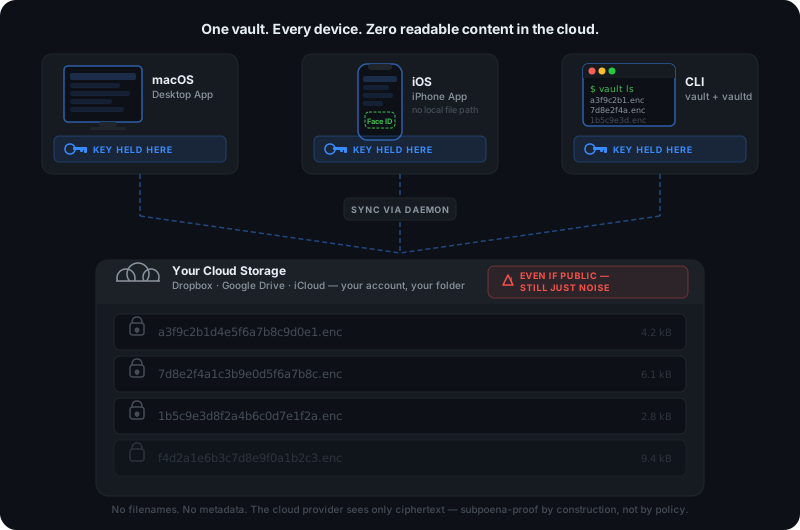
Encrypted documents go into Dropbox, Google Drive, or iCloud — infrastructure you already pay for. No new service to subscribe to.
Each person holds a cryptographic identity tied to their device. Team membership is a signed record — not an account in someone else's database.
When someone takes a local copy, it's watermarked and logged. You know exactly who extracted what, and when — and it's provable.
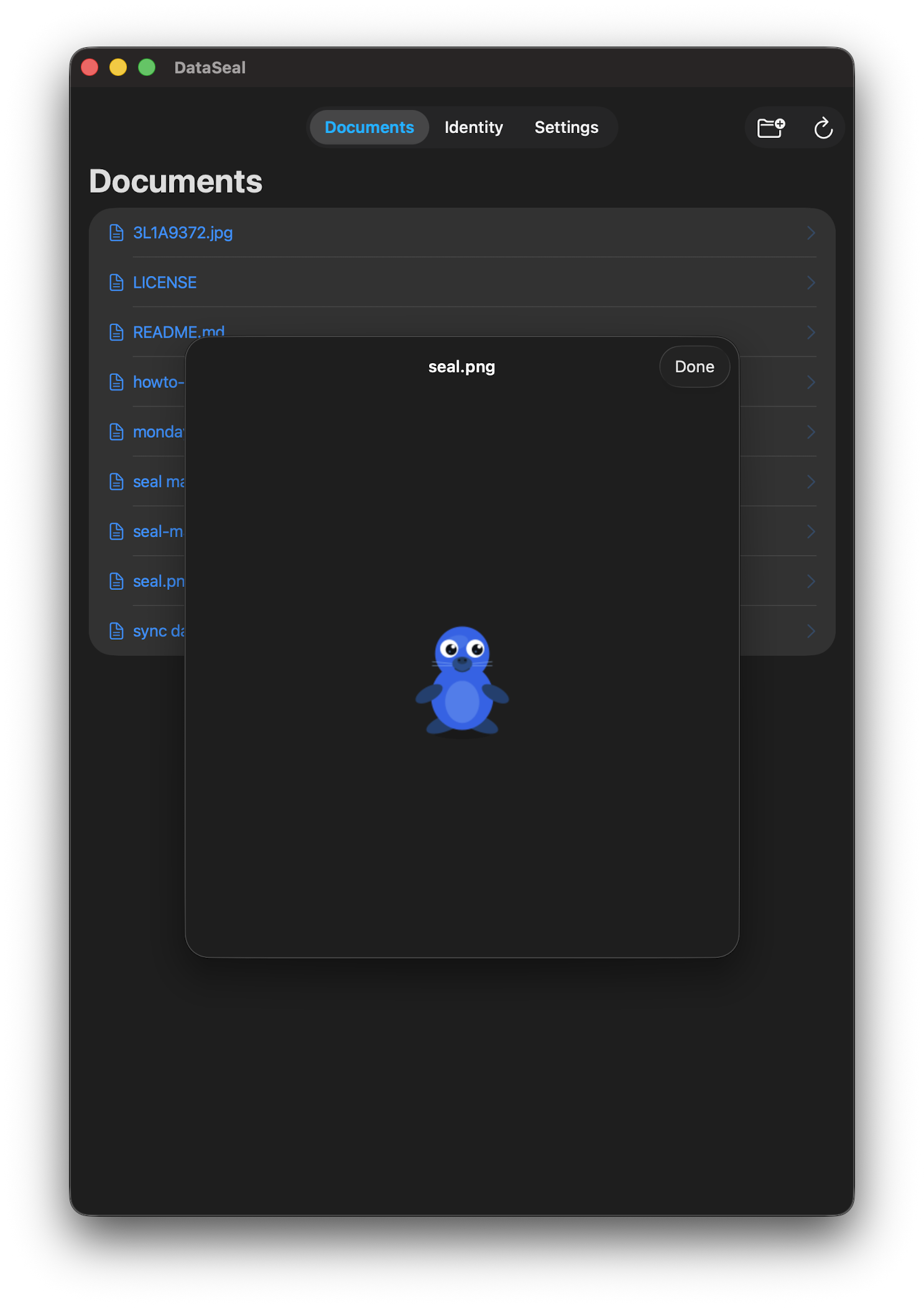
On iOS, documents live only in app memory behind biometrics. There is no path to a local file — by design, not policy.
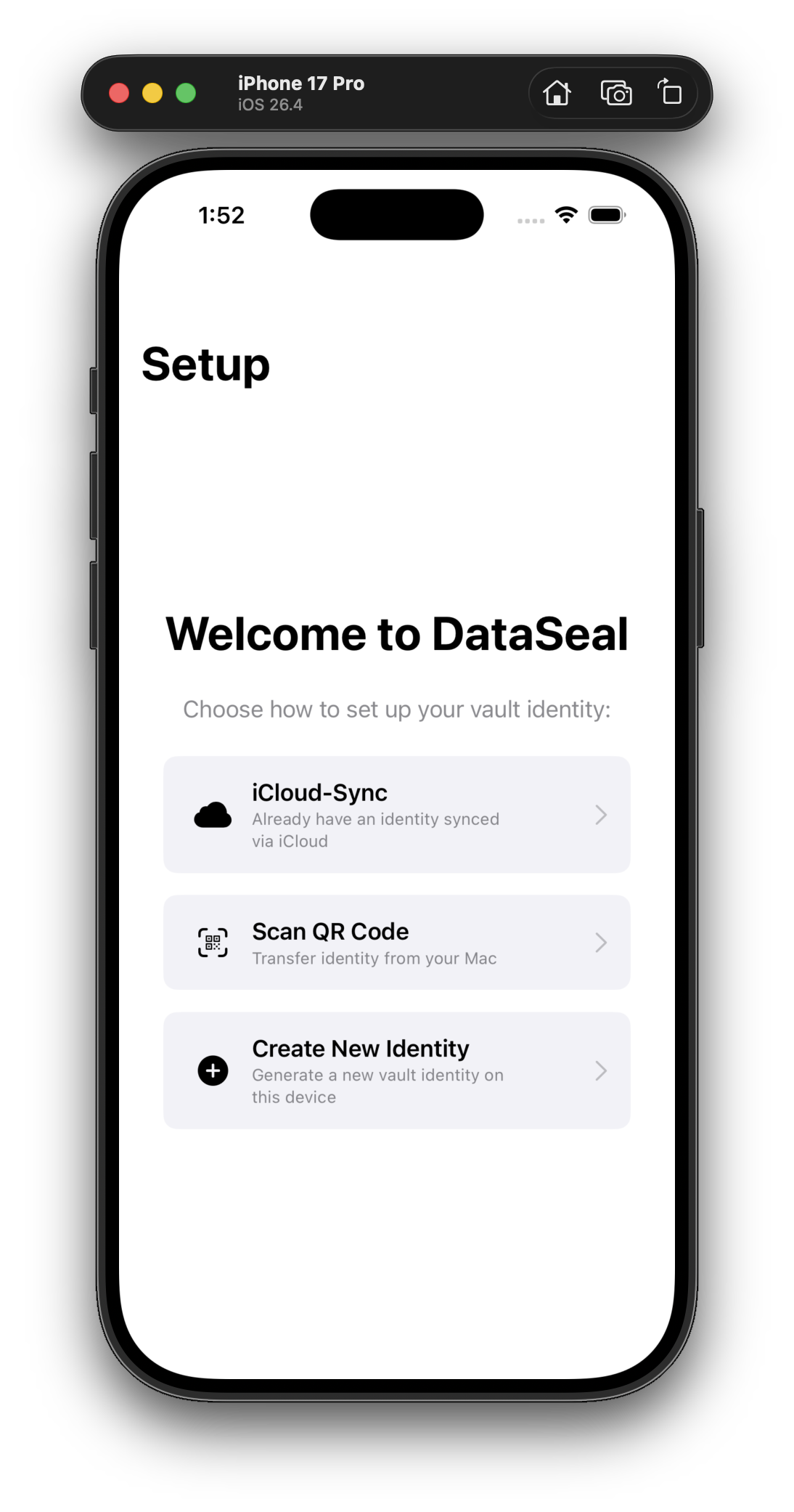
Pair your iOS and macOS devices by scanning a QR code. Your cryptographic identity moves securely — no cloud account, no email link.
A local daemon (vaultd) handles vault sync in the background. The CLI and macOS app both talk to it — same vault, multiple surfaces.
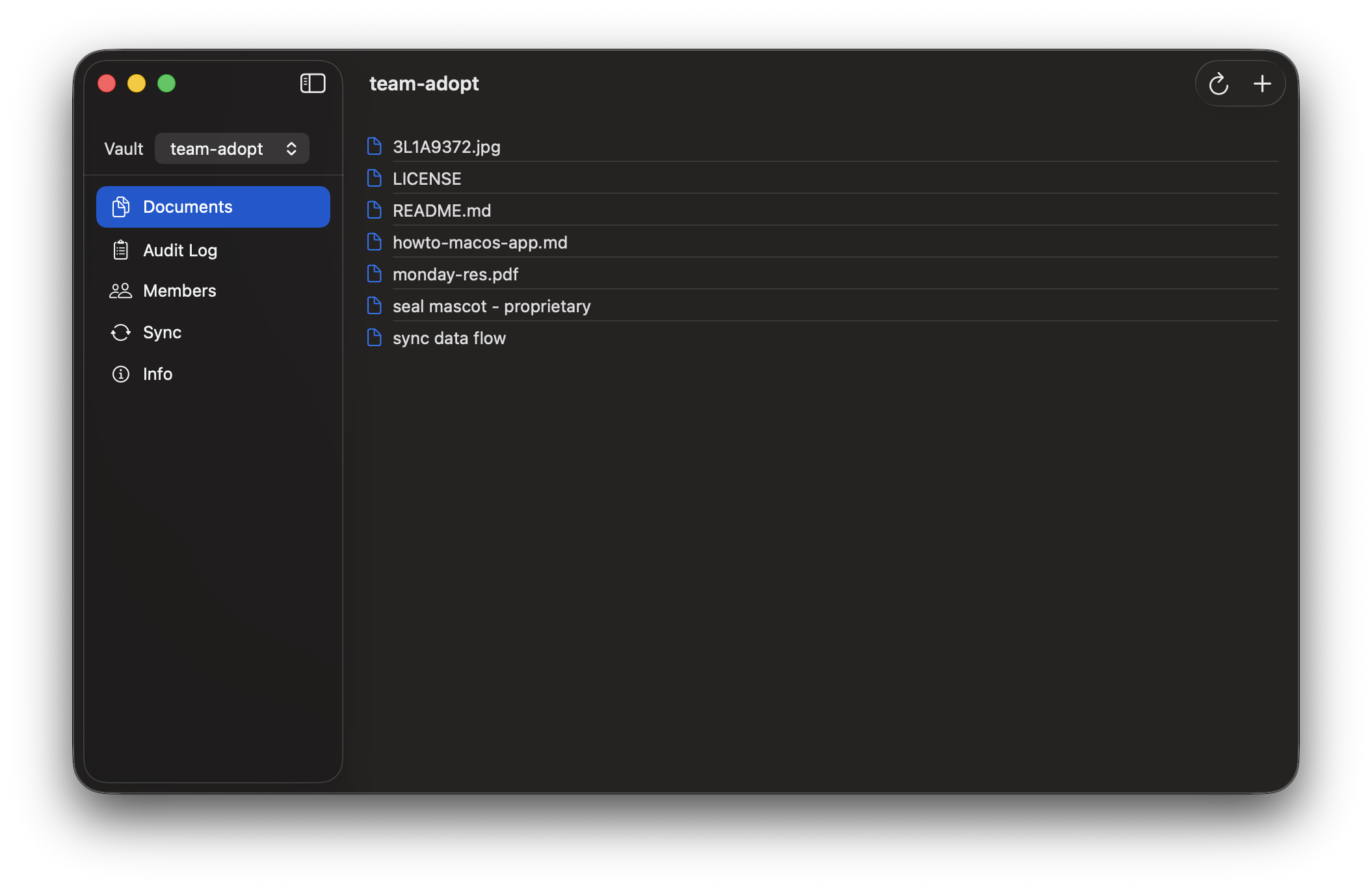
Any team that shares sensitive documents over standard cloud storage — without wanting to trust the cloud.
Privileged communications and discovery documents — shared securely, inaccessible to the storage provider. End-to-end encrypted, with a tamper-evident record of every access.
Account statements, estate plans, and sensitive client records — without relying on a separate secure portal. Your Dropbox holds only encrypted noise.
Tax returns and workpapers shared with clients — encrypted in transit and at rest, with a cryptographic record of every open and extraction.
Patient records shared between providers — end-to-end encrypted, audit trail included, aligned with HIPAA access-control requirements.
A deal room without a dedicated deal room service — encrypted documents shared through your existing cloud storage, revocable the moment the deal closes.
Minutes, compensation records, and legal filings — restricted to the right people, with a tamper-evident log that proves who saw what and when.
Infrastructure secrets, internal specs, and proprietary source — sealed in cryptography, not access policy. No central server to subpoena.
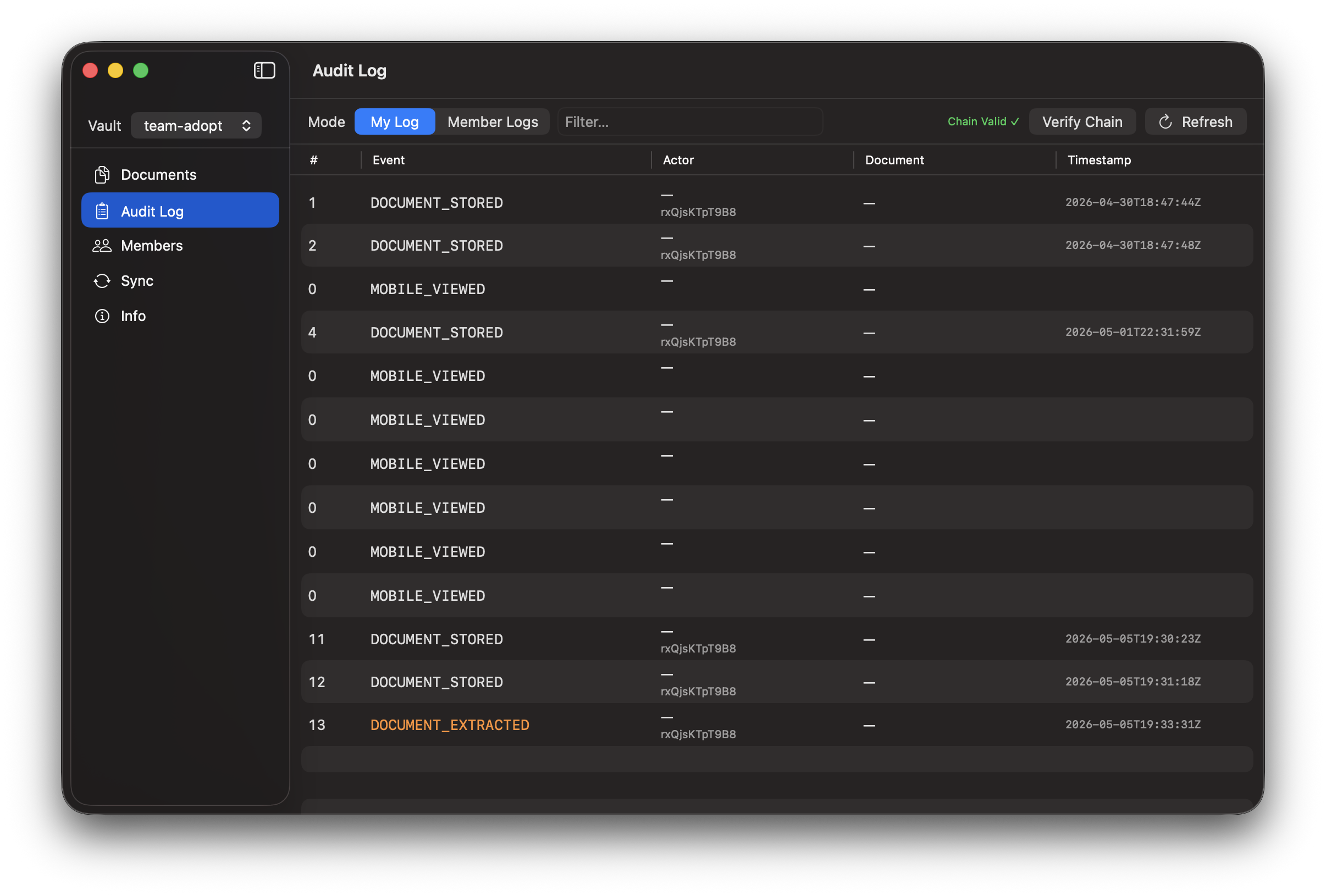
Conventional audit logs are mutable files. Any admin with write access can delete lines, edit entries, or forge attribution. Data Seal builds tamper evidence directly into the log — every entry is cryptographically linked to the one before it. Modify or remove any entry and the chain breaks, detectable by anyone with the log. Every event is also signed by the person who caused it, so attribution can't be forged even by someone with direct filesystem access.
The log records every access, open, extract, and membership change — with a verified identity, a timestamp, and a reference to the document. It is append-only and self-verifying.
The audit log is designed to satisfy the electronic-records requirements of:
Extraction events don't just get logged — the extracted document itself is marked. A forensic watermark is embedded at extraction time, tied to the audit entry. If a file leaks, the watermark traces it back to exactly who took it and when. It survives most common editing paths.
The core vault, audit log, and daemon have been running in daily use for months. macOS and iOS apps are both in private alpha. The CLI ships with every install.
vault + vaultd)
Available
vault + vaultd
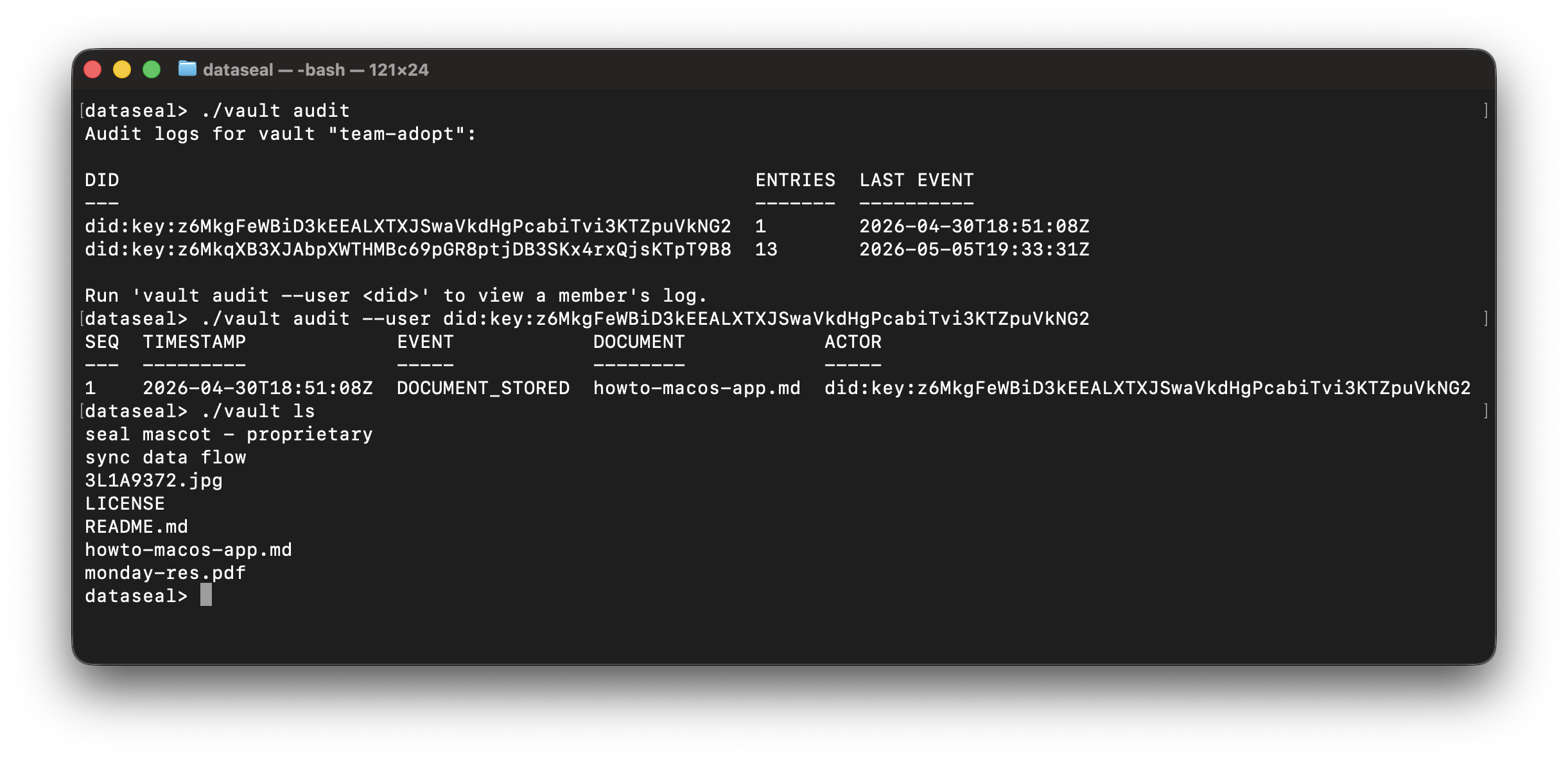
vault ls lists your encrypted documents. vault audit prints the verified event chain.
vaultd runs the sync daemon the apps talk to.
The SDK gives applications direct access to the vault — encrypt, decrypt, list, audit, and manage team membership without going through the desktop apps. Available for TypeScript, Python, and Swift.
Data Seal is in private alpha. The SDK, vault, and CLI are functional — we use them daily. If you're building something that needs zero-trust document storage with a real audit trail, reach out. We'll give you access and talk through the integration.
| Threat | How it's handled |
|---|---|
| Cloud provider subpoenaed | Your cloud storage holds only encrypted blobs — no readable filenames, no metadata, nothing that can be deciphered without your keys |
| Device compromised | Documents exist only in protected application memory during an active access window — closed or timed out, they're gone |
| Team member leaves | Remove them from the team; their access is revoked immediately — no key, no access, enforced by the vault itself |
| Document leaked after extraction | Every extraction is logged and watermarked; the watermark traces the file back to exactly who took it and when |
| Audit log tampered | Every entry is cryptographically linked to the one before it — modification, deletion, or insertion is immediately detectable |
| Mobile extraction | No export path on iOS; biometrics gate every open; documents clear from memory on close — by design, not policy |
Screen capture. Once a document is rendered on screen, it can be photographed. Data Seal controls access and attribution — it is not DRM.
A fully compromised machine. If the device running the vault is owned at the OS level, an attacker can access application memory. The vault is the trust boundary — not a magic black box.